3D pneumatics simulator
Pneumatics simulator: build real circuits on a 3D training workbench
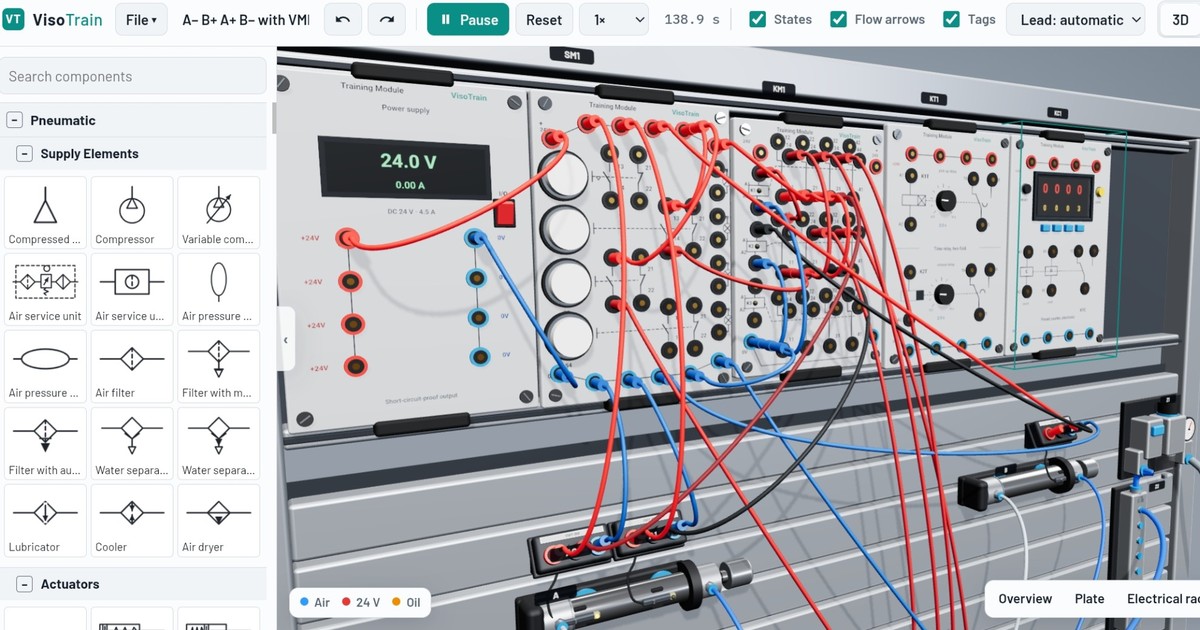
Design pneumatic control circuits with ISO 1219 symbols and real-looking hardware, run them in real time, and see the pressures, flows and motion — no installation, no lab booking.
What you can simulate
Actuators
Single- and double-acting cylinders, cylinders with guide unit, rodless linear drives, semi-rotary actuators, air motors and vacuum suction.
Directional valves
3/2 and 5/2 valves with push button, selector, roller lever, pneumatic pilot (impulse and spring return) and 5/3 closed-centre valves.
Logic and timing
Shuttle valve (OR), two-pressure valve (AND), time delay valves, pressure sequence valves, quick exhaust and flow control (meter-in / meter-out).
Air supply
Compressor, service unit with filter-regulator and gauge, manifold distributor, reservoirs, pressure gauges and flow meters.
Sequences
Displacement-step diagrams, blocking signals and their removal (idle return rollers, signal shortening), cascade control, stepper modules (TAA/TAB), the Quickstepper sequencer and stepping chains.
Industrial machines
Watch the circuit you built drive a 3D magazine feeder, press, clamping fixture, lift-and-transfer station or drilling station.
How a pneumatics lesson works in VisoTrain
- Place components from the library (search by name, function or designation such as 1V1 or “5/2 solenoid”).
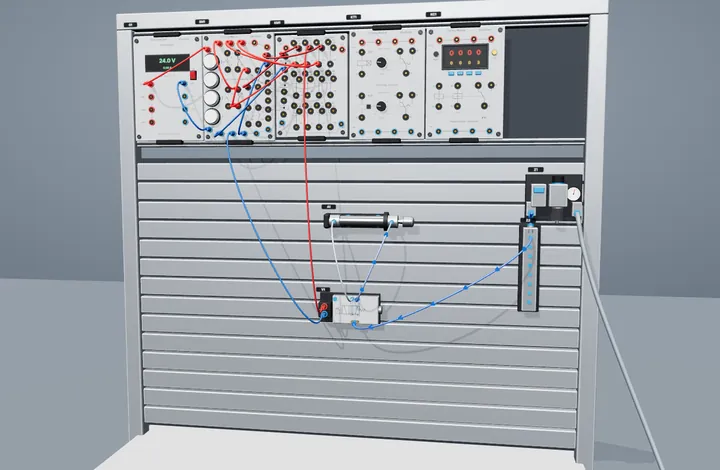
- Connect ports with tubes — unconnected outlets exhaust to atmosphere exactly as on a real bench.
- Run the simulation: lines turn blue when pressurised, valve spools move, cylinders extend and retract.
- Switch to the live circuit diagram (ISO 1219 symbols) side by side with the 3D view.
- Check your solution against the exercise specification — the automatic test operates your circuit and explains every requirement.
Graded pneumatics exercises
Classic university and vocational-training exercises, each with a verified reference solution:
- Direct control of a single-acting cylinder — Build a circuit in which a single-acting cylinder extends while the push button valve S1 is held, and retracts by its spring as soon as S1 is released.
- Direct control of a double-acting cylinder — A double-acting cylinder must extend while S1 is held and retract when it is released. Both chambers must be driven by air — no spring.
- Indirect control with memory — A short press on S1 extends the double-acting cylinder and it stays extended. A short press on S2 retracts it and it stays retracted. (S1 is the left push button, S2 the …
- OR function: two places to start — A single-acting cylinder must extend while S1 or S2 (or both) is held — for example a machine that can be operated from two sides.
- AND function: two-hand safety — For safety the single-acting cylinder may only extend while S1 and S2 are both held. One button alone must not move it.
- Speed control: slow extension, fast return — With a selector switch valve the double-acting cylinder extends (switch on) and retracts (switch off). The extension must take between 2 and 8 seconds; the return must be…
- Automatic return with a roller lever valve — A short press on S1 starts one cycle: the double-acting cylinder extends and returns automatically when it reaches the front end position. It must then stay retracted unt…
- Continuous cycle with a selector switch — While the selector switch is on, the double-acting cylinder moves back and forth continuously. When it is switched off, the cylinder finishes its cycle and stops retracte…
- Timed return (pneumatic timer) — A short press on S1 extends the double-acting cylinder. At the front end position it must wait at least 1 second and then return by itself.
Blocking signals (signal overlap)
- Blocking signals: idle return rollers (A+ B+ B− A−) — One press of S runs A+ B+ B− A− once. Wired directly, this circuit blocks twice: at rest b0 holds pilot 12 of the valve of A, so S cannot start A+; after B+ a1 still hold…
- Blocking signals: signal shortening with time delay valves — The same task, A+ B+ B− A− once per press of S, with ordinary roller lever valves this time. Remove the two blocking signals (b0 on the valve of A, a1 on the valve of B) …
- Find the blocking signal: A+ A− B+ B− — One press of S runs A+ A− B+ B− once. Draw the displacement-step diagram, find the blocking signal of the direct circuit (S → A+, a1 → A−, a0 → B+, b1 → B−) and remove it…
- Four blocking signals: A+ B+ C+ C− B− A− — Three double-acting cylinders A, B, C (left to right), all retracted at rest. One press of S runs A+ B+ C+ C− B− A−. With direct roller signals this sequence has four blo…
- Electrical blocking signals: A+ B+ B− A− with a group relay — Cylinders A and B with 5/2 double solenoid (impulse) valves and proximity sensors. One press of S2 runs A+ B+ B− A− once. Wired directly (S2 → Y1 of A, a1 → Y1 of B, b1 →…
- Find the electrical blocking signal: A+ A− B+ B− — Cylinders A and B with 5/2 double solenoid (impulse) valves and proximity sensors. One press of S2 runs A+ A− B+ B− once. Wired directly (S2 → A+, a1 → A−, a0 → B+, b1 → …
Sequences, cascades and stepping chains
- Sequence A+ B+ A− B− (direct signals) — Two double-acting cylinders A (left) and B (right). One press on the start button S runs the sequence A+ B+ A− B− once. Use roller lever valves as end-position signals (a…
- Sequence A+ B+ B− A− with a 2-group cascade — Start button S runs A+ B+ B− A− once. With direct roller signals this sequence blocks (signal overlap at the 5/2 valve of B). Solve it with a cascade: a group valve switc…
- Sequence A+ A− B+ B− with a 3-group cascade — Start button S runs A+ A− B+ B− once. Both cylinders change direction twice, so the signals overlap twice: build a 3-group cascade (GR.1 A+, GR.2 A− B+, GR.3 B−) with two…
- Quickstepper: A+ B+ B− A− — Use the Quickstepper (pneumatic sequencer) to run A+ B+ B− A− once per press of S. Each step drives one valve pilot; each transition condition is a roller valve.
- Stepper modules (TAA / TAB): A+ B+ B− A− — Build a stepping chain with stepper modules: one initial step module TAB and four step modules TAA. One press of S runs A+ B+ B− A−. Each module is set by the previous st…
- Electropneumatic sequence A+ B+ A− B− — Cylinders A and B with 5/2 double solenoid valves and magnetic proximity sensors at both end positions. A press of S2 runs A+ B+ A− B− once.
- Electrical stepping chain: A+ B+ B− A− — Build an electrical stepping chain with relays for A+ B+ B− A− (one cycle per press of S2). Each step relay latches itself, is set by the previous step AND its sensor, an…
- Pneumatic stepping chain: A+ A− B+ B− — Solve A+ A− B+ B− (one cycle per press of S) with a pneumatic stepping chain: one block per step, each made of a memory valve (impulse valve) and a two-pressure valve (AN…
- Three cylinders: C+ A− B+ B− A+ C− — Three double-acting cylinders A, B, C (left to right). At rest A is extended, B and C are retracted. One press of S runs C+ A− B+ B− A+ C−. Any method is accepted: a 6-bl…
- Quickstepper: C+ A− B+ B− A+ C− — The same machine (A extended at rest, B and C retracted): run C+ A− B+ B− A+ C− once per press of S, this time with the Quickstepper. Its six steps match the six movement…
Example circuits included
- Direct control · single-acting — A 3/2 push-button valve extends the single-acting cylinder; on release the spring retracts it. Hold the green button.
- Indirect control with memory — S1 pilots 14 and S2 pilots 12 of a bistable 5/2 valve. The flow control valve on the exhaust (meter-out) sets the extension speed.
- Automatic cycle with roller valves — With the selector switch on, the cylinder oscillates: roller valve A0 (retracted) AND selector → 14; roller valve A1 (extended) → 12.
- Timed return (pneumatic) — S1 extends the cylinder; at the end position the roller valve A1 feeds the time-delay valve, which pilots the return after the delay.
- Cascade A+ A− B+ B− — Two cylinders in the sequence A+ A− B+ B− with a 3-group cascade (GR.1 A+, GR.2 A− B+, GR.3 B−). Two memory valves switch the group lines; the roller valves a0, a1, b0, b1 are supplied from the group lines. Press start (Shift+click for continuous cycles).
Frequently asked questions
Is there a free online pneumatics simulator?
Yes. VisoTrain runs in the browser and the Free plan gives two 30-minute sessions a day with all 178+ components, examples and exercises.
Does VisoTrain use standard pneumatic symbols?
Yes. The circuit diagram uses ISO 1219-1 symbols, ISO 5599 port numbering (1, 2, 4, 3, 5, 12, 14) and designations such as 1A1, 1V1 and 1S1.
Can I simulate cascade and stepper circuits?
Yes: 2- and 3-group cascades, pneumatic stepping chains with memory valves, stepper modules TAA/TAB and a Quickstepper sequencer are included, with graded exercises.
Are there exercises on blocking signals (signal overlap)?
Yes: find the blocking signal of a sequence and remove it with idle return roller valves, signal shortening with time delay valves, or — in electropneumatics — a group relay or a memory relay. Each exercise is graded automatically.
Is VisoTrain an alternative to FluidSIM?
VisoTrain is an independent browser-based simulator with its own 3D workbench, graded exercises and machine views. It is not affiliated with Festo or FluidSIM.
Do I need to install anything?
No. It runs in a modern browser on Windows, macOS, Linux, ChromeOS and tablets.