Electrical installations and motor control
Electrical installations and motor control on a 3D training panel
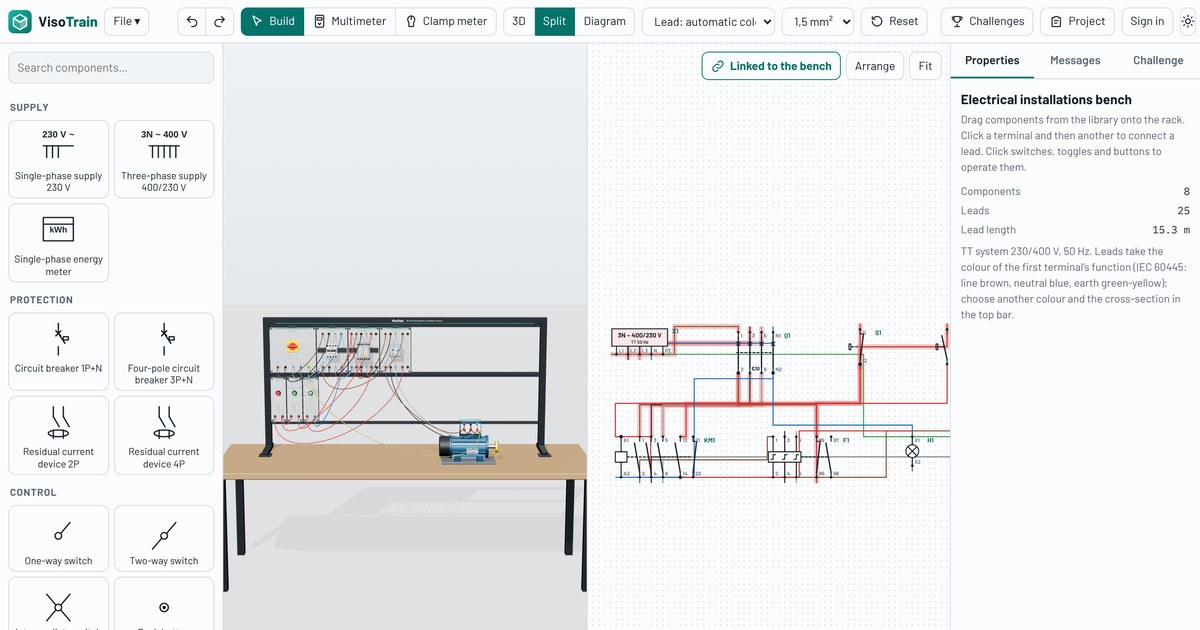
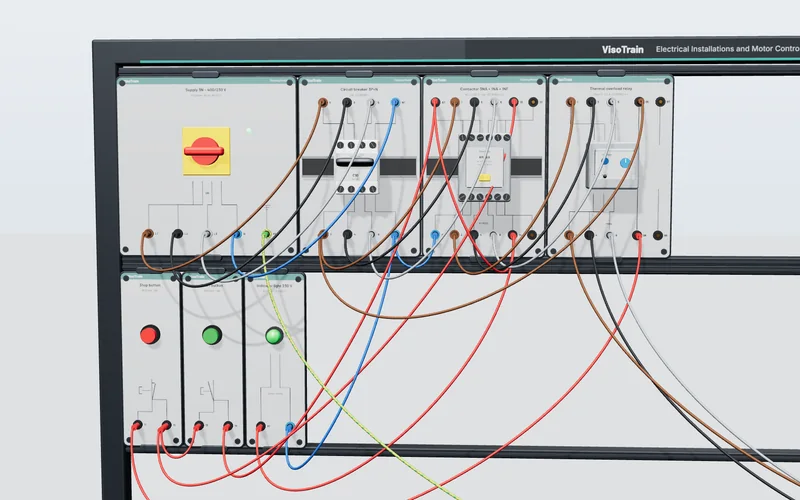
Mount protection, switching and control devices on a rack of A4 training panels, connect them with 4 mm safety leads and switch the supply on: the simulator solves the 230/400 V, 50 Hz circuit, trips circuit breakers and residual current devices, runs three-phase motors and keeps the wiring diagram in step with the bench.
What you can build
Lighting and sockets
One-way, two-way and intermediate switching, impulse relays, staircase timers, twilight switches, motion detectors and socket-outlet circuits with protective earth.
Protection
Miniature circuit breakers (IEC 60898-1) that trip on overload and short circuit, and 30 mA residual current devices (IEC 61008) that trip on an earth fault.
Motor control
Contactors and thermal overload relays (IEC 60947-4-1), direct-on-line and forward/reverse starters with interlocking, timers and three-phase induction motors with U1 V1 W1 terminals (IEC 60034-8).
Wiring diagram linked to the bench
3D, split and diagram views. Every lead you place on the panel appears in the diagram and the other way round; the link can be switched off to draw first and wire later.
Measure like a technician
A multimeter between any two terminals and a clamp meter on any lead, with conductor colours to IEC 60445: brown line, blue neutral, green-yellow earth.
Bill of materials
The project dialog lists devices, cable lengths and accessories; enter your own supplier prices and export the list as CSV.
Component library (27 devices)
Supply
- Single-phase supply 230 V — Incoming supply (line, neutral and protective earth). Click to switch it on and off.
- Three-phase supply 400/230 V — Three-phase incoming supply with neutral and earth. Click to switch it on and off.
- Single-phase energy meter — Electronic active-energy meter (EN 50470-3, class B), connected 1-3 (line) and 4-6 (neutral). Shows the power and the energy consumed downstream.
Protection
- Circuit breaker 1P+N — Protects against overload (thermal) and short circuit (magnetic, curve C). Click the toggle to reset it.
- Four-pole circuit breaker 3P+N — Protection of three-phase circuits (curve C).
- Residual current device 2P — Trips when the current leaving on the line does not return on the neutral (earth leakage). 30 mA protects people.
- Residual current device 4P — RCD for three-phase circuits with neutral.
Control
- One-way switch — Switches a circuit on and off from one place. Click to operate it.
- Two-way switch — Two two-way switches control the same lamp from two places (stairs, corridors).
- Intermediate switch — Placed between two two-way switches, it adds more control points to the same circuit.
- Push button — Normally open contact that closes only while it is pressed (doorbell, impulse relay).
- Start button (green, NO) — Normally open contact 13-14.
- Stop button (red, NC) — Normally closed contact 11-12: opens while it is pressed.
- Emergency stop (mushroom head) — Red mushroom-head button on a yellow background (IEC 60204-1). Latches when pressed; click again to release it. Contact 11-12 NC.
- Staircase timer — A pulse from the push buttons on terminal 3 switches the light on (L → 1) for the set time; it then switches off by itself. A new pulse restarts the count.
- Motion detector 230 V — 3-wire passive infrared (PIR) sensor: switches on the load connected to L′ when it detects a person and switches it off after the set time. Click the sensor to simulate a person walking past.
- Twilight switch — Photocell that switches outdoor lighting on at dusk (L → L′) and off in daylight. Click to toggle day and night.
Loads
- Socket outlet with earth (Schuko) 16 A — General-purpose socket outlet. Choose the appliance plugged in; "fault" simulates a leak from the line to the metal enclosure.
- Lighting point (lamp) — Luminaire with an E27 lamp holder and an earth terminal.
- Bell 230 V — Rings while it is energised.
- Indicator light 230 V — Panel indicator lamp (running, fault).
- Industrial socket CEE 400 V 16 A — Red 3P+N+E socket (IEC 60309, IP44) for three-phase machines. Choose the power of the machine plugged in (balanced star-connected load).
Motors and control
- Impulse relay — Bistable relay: each pulse on the coil changes over the contact (several push buttons control the same light).
- Contactor 3NA + 1NA + 1NF — Switch operated by a 230 V coil: three main contacts and two auxiliary contacts (13-14 NO, 21-22 NC).
- Thermal overload relay — Protects the motor against overload: opens 95-96 when the current exceeds the setting for some time. Click to reset it.
- On-delay timer relay — After the coil is energised it waits for the set time, then switches 15-18 (NO) and 15-16 (NC).
- Three-phase induction motor 230/400 V Δ/Y — Squirrel-cage motor with terminals U1-U2, V1-V2, W1-W2 (IEC 60034-8). On a 400 V supply it is connected in star (bridge U2-V2-W2); in delta the windings get 400 V and burn out. It turns in the direction of the phase sequence; with a phase missing it does not start and overheats.
11 graded challenges
Each challenge is checked like an instructor would: the simulator copies your installation, operates switches and push buttons in a test sequence and measures what happens at the loads, including safety faults such as a switch in the neutral or a missing interlock.
- Doorbell with a push button (Installations, level 1) — Wire a doorbell controlled by a push button, protected by a 30 mA RCD and a 10 A circuit breaker.
- Lighting point with a one-way switch (Installations, level 1) — A lamp controlled by a one-way switch. Protection: 30 mA RCD and 10 A circuit breaker. The switch must break the line conductor and the luminaire must be earthed.
- Two-way switching (Installations, level 2) — The same lamp controlled from two places with two two-way switches (staircase or corridor). 30 mA RCD, 10 A circuit breaker, earthed luminaire.
- Three control points (intermediate switch) (Installations, level 3) — A lamp controlled from three places: two-way switches at the ends and an intermediate switch in between.
- Socket-outlet circuit (Installations, level 2) — Two Schuko socket outlets on a 16 A circuit, wired in 2.5 mm² cable and both earthed. An insulation fault in either of them must trip the RCD.
- Impulse relay with three push buttons (Installations, level 2) — A corridor lamp controlled by three push buttons through an impulse relay.
- Direct-on-line motor starter with self-holding (Motor control, level 3) — Three-phase motor with a contactor, a thermal overload relay set for the motor, start and stop buttons (self-holding) and a running indicator. The overload contact (95-96) must break the control circuit.
- Forward/reverse starter with interlock (Motor control, level 4) — Two contactors (KM1 forward, KM2 reverse) swapping two phases, a start button for each direction, a common stop and electrical interlocking through contacts 21-22: the two contactors must never be on at the same time.
- Delayed start with warning (Motor control, level 3) — Pressing start lights a warning indicator and the motor starts only 5 s later (timer relay). Stop switches everything off.
- Troubleshooting: dangerous socket outlet (Troubleshooting, level 2) — This installation works, but an appliance has an insulation fault and the RCD does not trip. Measure with the multimeter, find the cause and correct the wiring so that the RCD clears the fault.
- Building staircase with a staircase timer (Installations, level 2) — In a building, three push buttons (one per floor) switch on the two staircase lamps through a 30 s staircase timer; the light goes off by itself. Measure the consumption with an energy meter at the origin of the circuit.
Example installations
Simple lighting point · Staircase timer with energy meter · Outdoor light: twilight switch and motion detector · Two-way switching · Three points (intermediate switch) · Socket-outlet circuit · Impulse relay · Doorbell · Direct-on-line motor starter · Forward/reverse starter · Delayed start
Frequently asked questions
Does the simulator show the wiring diagram?
Yes. The diagram uses IEC symbols and stays linked to the 3D panel: a lead drawn in one view appears in the other. You can also switch the link off.
Which standards does the equipment follow?
Circuit breakers to IEC 60898-1, residual current devices to IEC 61008, contactors and overload relays to IEC 60947-4-1, conductor colours to IEC 60445 and motor terminal markings to IEC 60034-8.
Do I need to install anything?
No. The lab runs in a current browser with WebGL on Windows, macOS, Linux, ChromeOS, iPadOS and Android.